Accessible
Crawlers and retrieval systems need to reach, render, and interpret the relevant page and its supporting resources.
Generative engine optimization platform
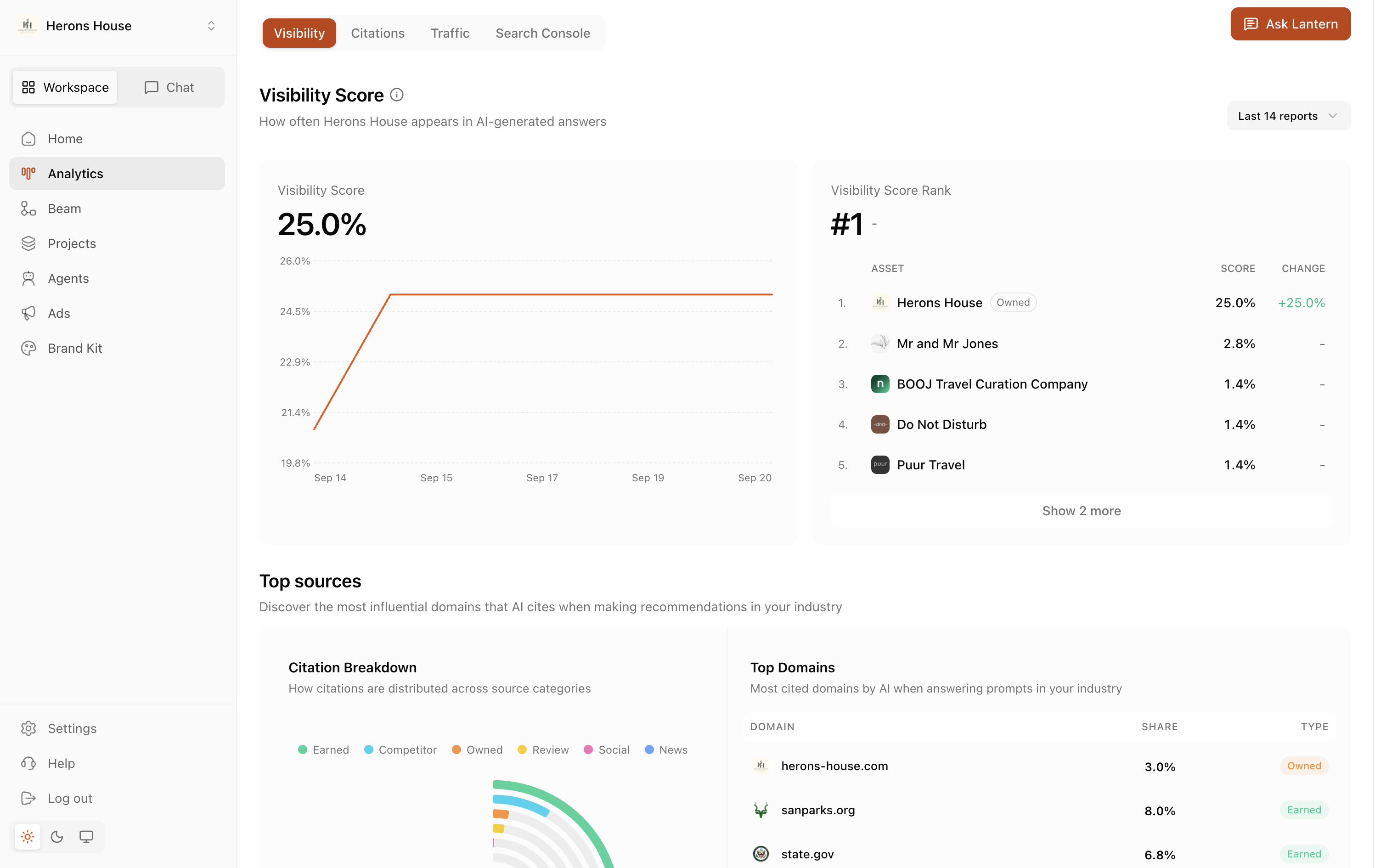
Measure where your brand appears, trace the sources shaping AI answers, diagnose citation gaps, and turn GEO evidence into review-ready marketing work.
Measure visibility across
 ChatGPT
 Google AI Overviews
 Gemini
 Perplexity
 Claude
A clear definition
Generative engine optimization, or GEO, improves how clearly and accurately a brand, product, or source can be understood, retrieved, mentioned, and cited in AI-generated answers.
GEO adds prompts, answer coverage, citations, cited domains, recommendation position, sentiment, and AI referral traffic to the technical, content, entity, and authority signals familiar to SEO teams.
It does not guarantee inclusion in an answer. Models and retrieval systems change, and outputs vary by prompt and context. GEO gives teams evidence about current visibility and a disciplined way to improve the signals they control.
How GEO works
There is no single GEO ranking formula. Source selection typically depends on whether information is available, relevant, well-supported, and credible for the question being answered.
Crawlers and retrieval systems need to reach, render, and interpret the relevant page and its supporting resources.
The content needs to answer the real question clearly, cover the topic deeply, and match the user and market context.
Specific claims are stronger when they include verifiable facts, original evidence, qualified sources, and clear attribution.
Consistent entities, independent mentions, useful references, and topical expertise help systems assess whether a source is credible.
GEO toolset
Connect the answer, source, competitor, technical, and execution layers of a GEO program in one workspace.
Visibility
01Track high-value questions across generative engines and see when, where, and how your brand appears in their responses.
Citations
02Identify the domains and pages supporting AI answers, then examine which sources recur across topics, engines, and competitors.
Competition
03Compare mentions, citations, recommendation position, and answer coverage with the brands competing for the same demand.
Research
04Expand one customer question into the related subqueries, entities, comparisons, and evidence a generative system may investigate.
Technical
05Check whether major AI crawlers can access your site and find technical directives that may limit discovery or retrieval.
Content
06Find missing answers, weak evidence, unclear entities, structural gaps, and source opportunities in existing or planned content.
Execution
07Turn verified gaps into audits, briefs, FAQs, comparison pages, content refreshes, and new assets for team review.
Reporting
08Connect prompt coverage, citations, competitors, referral traffic, and completed work in one stakeholder-ready view.
A measurable GEO workflow
Map the questions buyers ask while discovering, comparing, validating, and choosing solutions in your category.
Stage output
Priority query universe
Compare engines, competitors, citations, sentiment, answer accuracy, and the pages shaping each response.
Stage output
Evidence-backed gaps
Improve accessibility, answer clarity, entity context, factual support, source value, and topic coverage where evidence supports it.
Stage output
Review-ready work
Monitor new answers, citations, competitor movement, and referral outcomes, then use the evidence to choose the next action.
Stage output
Updated GEO priorities
GEO agent execution
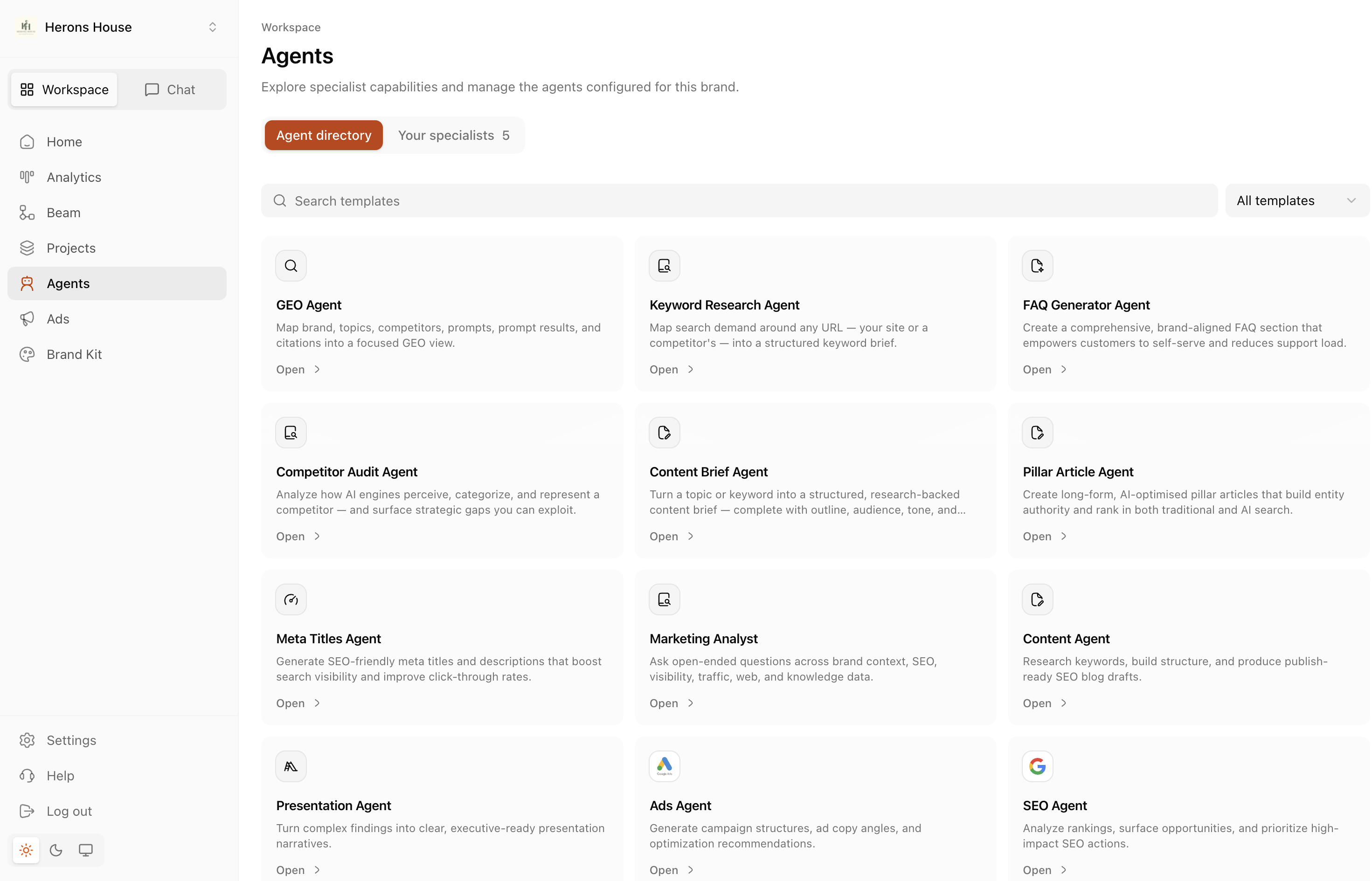
Use specialized agents for query research, competitor audits, content briefs, FAQs, comparison pages, source reviews, and GEO optimization.
GEO, SEO, and AEO
The disciplines overlap. The main difference is the discovery surface and the evidence used to measure whether optimization is working.
| Area | SEO | AEO | GEO |
|---|---|---|---|
| Primary surface | Ranked search results and search features | Direct answers and answer boxes | Generative and conversational AI answers |
| Demand model | Keywords, queries, and search intent | Questions and concise answer intent | Prompts, query fanout, journeys, and comparisons |
| Visibility | Rankings, impressions, clicks, and traffic | Answer inclusion and featured-result ownership | Mentions, citations, recommendation position, and share of voice |
| Shared foundation | Technical access, useful content, authority, entities, evidence, and clear structure | Technical access, useful content, authority, entities, evidence, and clear structure | Technical access, useful content, authority, entities, evidence, and clear structure |
GEO resources
Free tool
Explore the related questions, entities, and research paths a generative system may use before composing an answer.
Open resourceFree tool
Test whether leading AI user agents can access your site and review the directives affecting crawler discovery.
Open resourcePlaybook
Learn how answer structure, original evidence, source authority, and useful information support AI-search visibility.
Open resourceGenerative engine optimization FAQ
Direct answers about GEO, AI citations, measurement, and the relationship with SEO and AEO.
Generative engine optimization, or GEO, is the practice of improving how clearly and accurately a brand, product, or source is understood, retrieved, mentioned, and cited in AI-generated answers. GEO combines technical accessibility, content quality, entity clarity, evidence, authority, and measurement across generative search experiences.
SEO primarily measures visibility in ranked search results through rankings, impressions, clicks, and organic traffic. GEO also measures prompts, AI mentions, citations, recommendation position, answer accuracy, and competitive share of voice. GEO extends strong SEO foundations rather than replacing them.
Answer engine optimization focuses on making information suitable for direct answers. Generative engine optimization focuses more broadly on how generative systems retrieve sources, synthesize information, describe entities, and cite or recommend brands. In practice, AEO, GEO, and SEO overlap.
No. No platform can guarantee a citation or recommendation because generative answers vary by model, retrieval system, prompt, market, and time. GEO provides evidence about current visibility and helps teams improve the signals they control.
A useful GEO tool should measure prompt coverage, brand mentions, citations, cited sources, competitors, recommendation position, answer accuracy, sentiment, share of voice, and AI referral traffic. It should also connect those findings to clear actions and ongoing measurement.
Lantern monitors major AI discovery surfaces including ChatGPT, Gemini, Perplexity, Claude, and Google AI Overviews. Coverage can vary by market and program configuration.
Lantern agents use AI-visibility evidence and shared brand context to complete defined workflows for research, audits, briefs, FAQs, content, and optimization. The work returns to marketers for review, revision, approval, and publishing.
From visibility to action
Connect your brand context, understand where demand is moving, and put specialized agents to work on the opportunities that matter most.
Start my free trial