Content Engineering: What a Content Engineer Does and How to Hire One
A complete guide to content engineering and the content engineer role: origins, responsibilities, skills, tools, comparisons with strategist, marketer and technical writer roles, a worked pipeline example, a job description template and a hiring process.
On this page
On this page
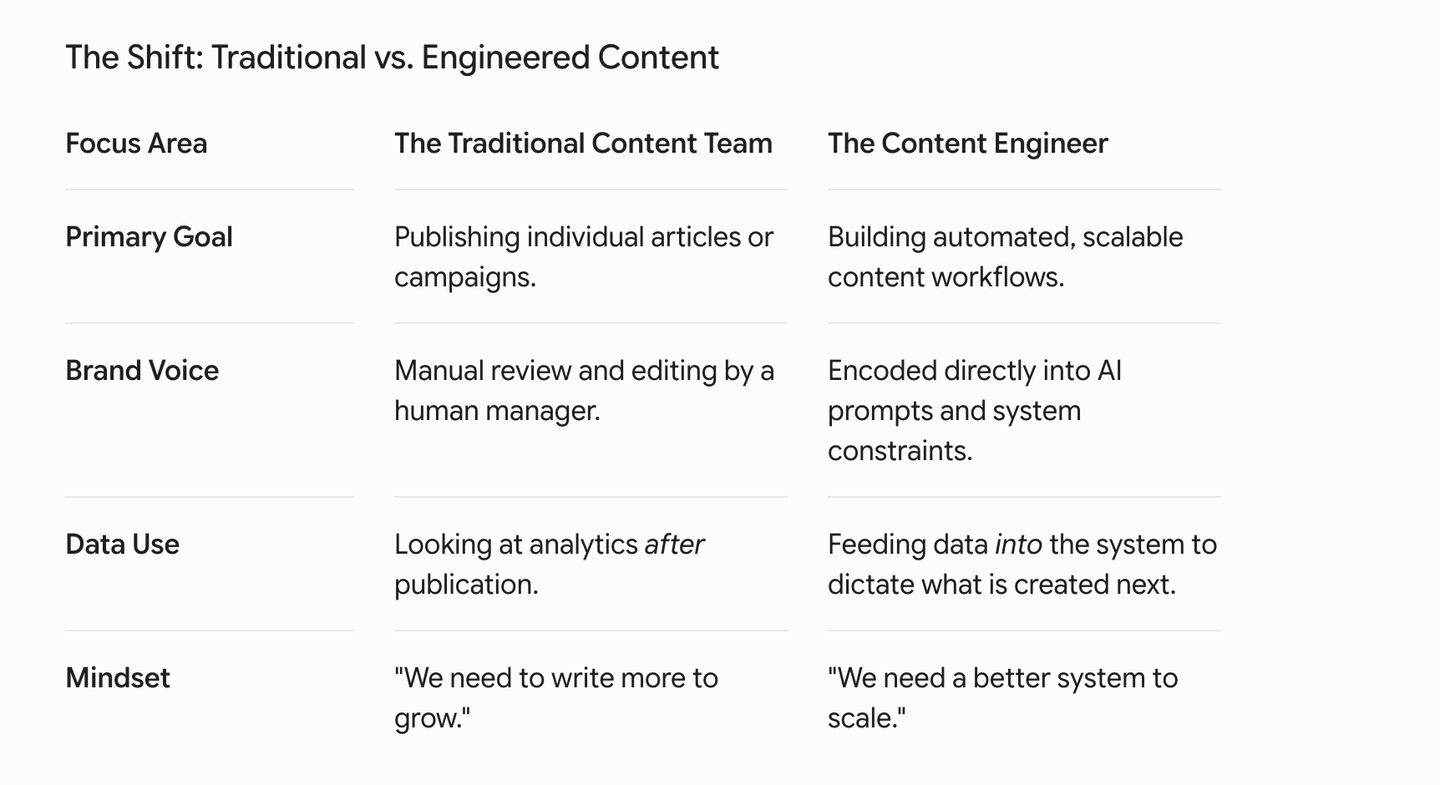
Content engineering is the practice of designing the systems that produce content: the data inputs, reusable brand context, structured templates, AI and automation workflows, review gates, publishing integrations and feedback loops. A content engineer builds and runs that system, so a team can ship accurate, on-brand content repeatedly instead of crafting every piece by hand.
This guide explains where the discipline came from, what a content engineer does day to day, the skills and tools involved, how the role differs from content strategist, content marketer and technical writer, a worked pipeline example, a copy-ready job description template and a practical hiring process.
What is content engineering?
Content engineering applies engineering principles (structure, reuse, automation, testing and measurement) to how content is planned, created, governed, delivered and improved. The output is a system, not an article.
The term has two lineages, and most confusion comes from mixing them up:
- Structured content engineering comes from technical communication and enterprise content management. In 2013, Mark Baker wrote that content engineering is not technical writing but "tool making and process engineering" that reduces variability so content can be automated. This tradition focuses on content models, taxonomies, metadata and reuse across channels. Content Science's overview of content engineering describes the same core: modeling, metadata and modular, structured content.
- AI-pipeline content engineering emerged in marketing in 2025 and 2026. Here a content engineer builds multi-step AI workflows for research, briefing, drafting, verification, optimization and distribution, usually aimed at search and AI search visibility.
The two are converging. AI agents work far better with structured context, clear output requirements and reliable metadata, which is exactly what the structured-content tradition has always produced.
| Structured content engineering | AI-pipeline content engineering | |
|---|---|---|
| Origin | Technical communication, CMS and DITA work, early 2010s | Content marketing and SEO teams, 2025 to 2026 |
| Core artifact | Content models, taxonomies, metadata, templates | Agent workflows, prompts and skills, knowledge bases, review gates |
| Typical tools | Headless CMS, CCMS, XML, schema.org | LLMs, agents, automation platforms, CMS APIs |
| Main goal | Reuse, consistency, multichannel delivery | Quality output at scale, search and AI visibility |
| Typical employer | Large enterprises, documentation teams | SaaS marketing teams, agencies, growth teams |
What does a content engineer do?
A content engineer designs, builds and maintains the production system a content team uses, then measures and improves it. They write too, but their main deliverable is the machine that makes good writing repeatable.
Core responsibilities usually include:
- Workflow architecture: mapping the path from opportunity to published, measured asset, and deciding which steps are automated and which need human judgment.
- Context modeling: turning brand voice, positioning, audience research, product facts and approved claims into a knowledge base every workflow and agent can use.
- Output contracts: defining what a valid brief, draft, refresh or FAQ must contain (sections, sources, word ranges, schema) so quality does not depend on an open-ended prompt.
- Building and running pipelines: configuring agents, prompts or reusable skills, automations and integrations with the CMS, analytics and search tools.
- Governance: setting evidence requirements, fact-checking steps, review gates and permissions before anything is published or sent.
- Content modeling and structure: designing templates, metadata and structured data so content can be reused and understood by search engines and AI systems.
- Measurement and iteration: tracking throughput, revision rates, rankings, AI citations, traffic and conversions, then changing the system based on results.
Demand data is still thin but consistent. When Ahrefs reviewed 20 US content engineer job postings from 2025 and 2026, about 85% mentioned building AI pipelines, 70% mentioned SEO, AEO or GEO, and 65% mentioned prompt engineering.
Content engineer vs content strategist, content marketer and technical writer
A content strategist decides what to create and why, a content marketer creates and distributes it, a technical writer documents a product, and a content engineer builds the system that makes all of that repeatable. The roles complement each other; small teams often combine them.
| Role | Primary question | Main output | Relationship with AI | Success measure |
|---|---|---|---|---|
| Content engineer | What system reliably produces and improves this? | Workflows, context, templates, integrations, feedback loops | Designs governed AI workflows end to end | Quality, throughput, reuse and outcomes |
| Content strategist | What should we create, for whom, and why? | Strategy, editorial plans, priorities | Uses AI for research and analysis | Audience and business impact of the portfolio |
| Content marketer | What asset will reach and convert this audience? | Articles, campaigns, social and email content | Uses AI to assist individual tasks | Traffic, leads and campaign results |
| Technical writer | How do users understand and use this product? | Documentation, guides, references | Uses AI for drafting and maintenance | Accuracy, task success, support deflection |
| Content operations manager | How do people, process and tools work together? | Calendars, processes, governance, tool administration | Selects and administers tools | Efficiency and on-time delivery |
Is content engineering the same as context engineering?
No, but they overlap. Anthropic defines context engineering as the set of strategies for curating and maintaining the right information in a model's context during inference. Content engineers practice context engineering when they build knowledge bases and brand context for agents, but their scope also covers editorial standards, publishing, governance and business measurement.
Content engineer skills
Content engineering is a hybrid skill set: editorial judgment plus systems thinking, with enough technical fluency to connect tools. Few candidates have every skill, so hire for the strongest two or three and train the rest.
| Skill | What good looks like | How to assess |
|---|---|---|
| Editorial judgment | Can tell a useful, accurate page from a fluent but empty one | Ask them to edit a weak AI draft and explain each change |
| Systems and workflow design | Breaks a process into stages with clear inputs, outputs and owners | Ask them to map your current publishing process and find the bottlenecks |
| Prompting and agent configuration | Writes reusable instructions and output specs, not one-off prompts | Review a prompt library or skill they have built |
| Content modeling and structured data | Designs templates, fields, taxonomies and schema.org markup | Ask them to model a product page or comparison page |
| SEO and AI search | Understands indexing, intent, citations and AI visibility metrics | Ask how they would raise citations for one priority query |
| Data and measurement | Connects Search Console, analytics and visibility data to decisions | Ask what they would measure in the first 30 days |
| Technical fluency | Comfortable with APIs, Markdown, JSON, CMS configuration and basic scripting | Walk through an integration they built |
| Governance and risk | Designs fact-checks, approvals and claim controls | Ask how they prevent an agent publishing an unsupported claim |
Do content engineers need to code?
Most marketing content engineers do not need to be software engineers, but they must be comfortable with technical systems. Reading API documentation, editing JSON or YAML, writing simple scripts, configuring automations and working with Git are common. Structured-content roles in documentation teams lean more technical, often including XML, DITA and CMS development.
Content engineering tools
A content engineering stack has six layers, and the tools matter less than how they connect. Map your stack by layer before buying anything.
- Demand and performance data: Google Search Console, analytics, keyword research and AI visibility data showing where your brand is or is not cited.
- Context and knowledge: a brand knowledge base with voice rules, positioning, product facts, approved claims and source documents.
- Generation and agents: language models, agents and reusable instructions (prompts or skills) for research, briefing, drafting and optimization.
- Orchestration and automation: workflow tools or code that chain steps together and pass context between them.
- Delivery: the CMS (WordPress, HubSpot, Sanity, Contentful and similar), CRM and collaboration tools.
- Governance and version control: review queues, approval rules, change history and audit trails.
Lantern's content engineering platform is built around these layers: search and AI visibility data, a shared brand knowledge base, specialized marketing agents, human review and approval, publishing integrations and performance feedback in one workspace. Lantern also publishes an open library of marketing skills for AI agents, such as content briefs, content refreshes and structured data, that content engineers can adapt.
A worked example: an engineered content refresh pipeline
The clearest way to understand the role is to see one system end to end. Here is a refresh pipeline a content engineer might build for a B2B blog, with the human checkpoints marked.
- Detect: each month, pull pages with falling clicks from Search Console and pages losing AI citations from visibility tracking. Output: a ranked list of refresh candidates.
- Diagnose: for each candidate, compare the page with current top-ranking and most-cited sources and list missing questions, outdated facts and weak structure. Output: a diagnosis per URL.
- Brief: generate a refresh brief using the brand knowledge base and a fixed brief template (intent, required sections, sources to verify, internal links). Human gate: an editor approves or edits the brief.
- Draft: an agent rewrites the page to the brief, keeping the URL and any strong existing sections. Output: a draft with every new claim tagged to a source.
- Verify: a second pass checks each claim, number and date against its source and flags anything unsupported. Human gate: a subject-matter expert reviews flagged items and product claims.
- Structure: add or update headings, tables, FAQ sections and structured data according to the page template. Run the internal linking rules.
- Publish: push the approved version to the CMS as a draft or scheduled update. Human gate: final editorial sign-off before it goes live.
- Learn: after 30 and 90 days, compare rankings, AI citations, traffic and conversions with the baseline, and feed the results into which pages are refreshed next.
What makes this engineering rather than "using AI" is that every stage has a defined input, output and quality bar, and the system improves from its own results. Freshness is a good first use case, because older content steadily loses AI citations and refreshes are repetitive enough to systematize.
Scale is not the goal: Google's spam policies define scaled content abuse as generating many pages primarily to manipulate rankings, explicitly including generative AI output that adds no value. Google's guidance on AI-generated content judges content by quality, not by how it was produced. A content engineering system should raise the quality bar, with verification and human review built in, not just raise volume.
How to hire a content engineer
Hire a content engineer when your content program is limited by process rather than ideas: you know what to publish, but quality varies, refreshes never happen, and AI tools are used ad hoc by each writer.
Signs you need one
- Writers each use AI differently and results are inconsistent.
- Briefs, refreshes and FAQ updates take weeks of manual coordination.
- Brand voice and product facts drift between pages and channels.
- You cannot say which content produced rankings, AI citations or pipeline.
- Publishing requires copy-pasting between tools.
Where good candidates come from
Strong content engineers often come from technical SEO, content operations, technical writing, marketing operations or growth roles, and from writers who have already built their own AI workflows. Ask for a portfolio of systems, not just articles: a pipeline diagram, a prompt or skill library, a content model or an integration they built.
A practical interview process
- Screen for systems thinking: ask them to describe a content workflow they improved and what changed in quality and speed.
- Take-home task: give them one of your weak pages and ask for a short refresh pipeline design with stages, inputs, outputs and review gates, plus one refreshed draft.
- Editorial test: have them edit an AI draft containing two factual errors and one off-brand claim. See whether they catch all three.
- Technical walkthrough: ask them to explain how they would connect your CMS, Search Console and a knowledge base.
- Stakeholder interview: check that they can work with writers and subject-matter experts without treating them as bottlenecks.
What the first 90 days should deliver
In the first 30 days, a content engineer should document the current workflow and build the brand knowledge base. By day 60, one pipeline (often refreshes or briefs) should be live with review gates. By day 90, there should be a baseline and first results from that pipeline, plus a backlog of the next systems to build.
Content engineer job description template
Use this template as a starting point and adjust the tools and seniority to your team.
# Content Engineer ## About the roleWe are hiring a Content Engineer to design and run the systems our marketing team uses to research, create, review, publish and improve content. You will turn our brand knowledge, search data and AI tools into reliable workflows that raise quality and speed, with clear human review at every critical step. ## What you will do- Map our content workflow from opportunity to measured result and redesign it into defined stages- Build and maintain our brand knowledge base: voice, positioning, product facts and approved claims- Create reusable prompts, skills, templates and output specifications for briefs, drafts, refreshes and FAQs- Configure AI agents and automations and connect them to our CMS, analytics and search tools- Set up fact-checking, review gates and publishing permissions- Design content models, metadata and structured data for key page types- Track throughput, quality, rankings, AI citations, traffic and conversions, and improve the system based on results ## What you will bring- 3+ years in content, SEO, content operations, technical writing or marketing operations- Strong editorial judgment and the ability to spot inaccurate or generic content- Hands-on experience building multi-step AI or automation workflows- Working knowledge of SEO and AI search visibility- Comfort with APIs, Markdown, JSON and CMS configuration; basic scripting is a plus- Clear documentation habits and the ability to train writers and editors ## How we measure success- Pipelines in production with documented inputs, outputs and review gates- Lower revision rates and shorter time from brief to publish- Measurable gains in rankings, AI citations and content-driven pipelineContent engineer salary and career path
Pay data for this title is limited and mixed, so treat any figure as directional. As of October 2026, Glassdoor's US content engineer salary page showed an average total pay of about $119,700 a year (median about $120,000), based on 44 self-reported salaries. The same title is used for several quite different jobs, so pay for marketing-focused roles may differ.
Common career paths run from content engineer to senior or lead content engineer, then to head of content operations, head of content or a marketing systems leadership role. Training options are emerging too, including Content Science Academy's content engineering certification and the AI content engineering program at Berghs School of Communication in Stockholm.
Common mistakes when building a content engineering practice
Most failed attempts automate a broken process or skip governance. Watch for these:
- Automating before documenting. If nobody can describe the current workflow, automating it just makes the confusion faster.
- Confusing volume with progress. More pages without original data or expertise is a spam risk, not a strategy.
- No source of truth. Without a maintained brand kit and knowledge base, every agent invents its own version of your product.
- Removing the human checkpoints. Review gates belong where errors are expensive: claims, pricing, legal, publishing and spend.
- Ignoring structure. AI systems lift passages, so clear headings and self-contained sections make content easier to reuse and cite.
- Not measuring. If the system does not track results, you cannot tell whether it is improving content or just producing more of it. Start with an AI search visibility baseline.
Frequently asked questions
What is the role of a content engineer?
A content engineer designs and runs the systems that produce content: workflows, brand context, templates, AI agents, integrations, review gates and measurement. Their goal is consistent quality at scale, with human judgment applied where it matters most.
Is content engineering a real job?
Yes. Companies now post roles titled content engineer and AI content engineer, and the structured-content version of the role has existed in documentation teams for more than a decade. Titles vary, so search for the responsibilities as well as the title.
How do I become a content engineer?
Start from your current strength. Writers and editors should learn workflow design, prompting and basic APIs; technical SEOs and operations specialists should build editorial judgment. The fastest proof is a portfolio: build one working pipeline, document it and show its results.
What is the difference between content engineering and content operations?
Content operations coordinates people, processes, calendars and tools. Content engineering goes deeper into how reusable context, structured outputs, agents, integrations and performance data are designed into the production system. Many teams start with operations and add engineering as AI use grows.
Does content engineering replace writers?
No. It removes repetitive coordination and first-draft work so writers, editors and experts can focus on judgment, original insight and voice. Teams that remove human review usually see quality fall and risk rise.
Content engineering turns content from a series of one-off projects into a system that improves with every cycle. If you are building that system, see our guide to marketing agents for AI search, and explore how Lantern connects visibility data, brand context, agents, review and publishing for content engineers.